Choosing a Project Management Approach with Cynefin
Categories:
Not every project needs Agile.
Not every project needs Waterfall.
And not every messy situation can be fixed by renaming meetings “ceremonies” and putting sticky notes on a wall. That is project-management cosplay. Stylish, maybe. Useful, only sometimes.
The better question is:
What kind of problem are we actually dealing with?
That is where the Cynefin framework helps. Cynefin is a sense-making framework for matching your response to the reality of the situation. It does not ask, “What process do we like?” It asks, “What domain are we in?”
Once you know the domain, the project-management approach becomes much easier to choose.
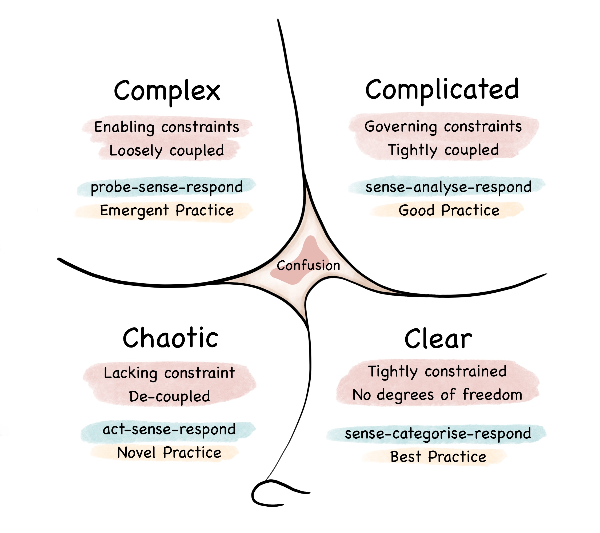

The short version
| Cynefin domain | Situation feels like | Team posture | Common fit |
|---|---|---|---|
| Clear / Obvious | Known problem, known answer | Follow the runbook | Checklist, standard process, Waterfall-ish execution |
| Complicated | Expert analysis needed | Diagnose, plan, coordinate | Kanban, staged delivery, expert-led planning |
| Complex | Outcome uncertain | Run experiments and learn | Scrum, prototypes, pilots, discovery work |
| Chaotic | Stability is gone | Act to contain, then reassess | Incident response, crisis management |
| Disorder | Nobody agrees what domain this is | Break the problem apart | Triage and classify |
The important part: these are tendencies, not laws. Cynefin is not a magic methodology vending machine. It is a way to stop forcing the same management style onto every kind of problem.
What Cynefin is for
Cynefin helps teams make decisions in context. The framework distinguishes between different domains so leaders and teams do not waste energy overthinking routine work or pretending complex work can be solved with a standard checklist.
That distinction matters because the wrong management style creates predictable failure modes:
- Use heavyweight planning for obvious work and the team slows down.
- Use rigid best practices for complex work and the team learns too late.
- Use open-ended experimentation during a crisis and the situation gets worse.
- Treat expert work as routine and you miss the details that actually matter.
Good project management starts with matching the approach to the problem.
Domain 1: Clear / Obvious
Known problem. Known answer. Stable cause and effect.
This domain is called Clear in many current Cynefin materials. Older articles often call it Obvious. The idea is the same: the team knows what is happening, the answer is well understood, and the work mostly needs disciplined execution.
How to manage it
Use standard process:
- checklists
- templates
- documented runbooks
- repeatable implementation plans
- well-defined acceptance criteria
- straightforward sequencing
This is where Waterfall-style planning can be perfectly reasonable. If the work is predictable, sequencing it up front is not a moral failure. Sometimes the Gantt chart is not the villain; the villain is pretending every project is a startup pivot.
Examples
- Publishing a guide after the template and workflow are known.
- Applying a routine dependency update with passing tests.
- Running a documented backup-restore validation.
- Rebuilding a known service from source-of-truth manifests.
- Creating a standard taxonomy using a proven methodology.
Watch out for
Complacency. Clear work can fall into chaos when people ignore exceptions or blindly follow a checklist after the context changes.
Domain 2: Complicated
There is an answer, but you need expertise to find it.
Complicated work has cause and effect, but the relationship is not obvious to everyone. You need analysis, domain knowledge, and sometimes multiple experts. There may be several good answers.
How to manage it
Use expert-led coordination:
- discovery interviews
- architecture reviews
- dependency mapping
- risk analysis
- phased implementation
- Kanban-style flow control
- decision records
Kanban often fits here because the team needs visibility, prioritization, and flow without pretending the answer is known on day one.
Examples
- Designing a knowledge-management roadmap.
- Choosing between database or search architectures.
- Planning a Kubernetes migration.
- Reviewing a security model.
- Selecting an integration approach across multiple systems.
Watch out for
Analysis paralysis. Complicated work needs expertise, but the team still needs a decision. Document the trade-offs, choose a path, and define what evidence would make you revisit it.
Domain 3: Complex
You cannot know the answer up front. You have to learn your way forward.
Complex work is not just “very complicated.” In a complex domain, cause and effect are only clear in retrospect. The team cannot reliably predict which solution will work before trying something.
How to manage it
Use experiments:
- prototypes
- spikes
- pilots
- short feedback loops
- parallel hypotheses
- user testing
- discovery sprints
- reversible decisions
Scrum can fit here when it is used for real learning: build a small thing, inspect the result, adjust the plan. Scrum becomes cargo cult when the team already knows the answer but keeps performing sprint theater anyway.
Examples
- Testing whether a new expert-finder system will actually help users.
- Piloting a community of practice before scaling it.
- Validating a new agent workflow with real operators.
- Exploring whether a local AI tool improves a team process.
- Investigating intermittent performance or reliability behavior.
Watch out for
Premature certainty. Complex work punishes teams that commit too early. Keep experiments small, define learning goals, and avoid irreversible changes until the pattern is clearer.
Domain 4: Chaotic
The situation is unstable. Waiting for perfect understanding is unsafe.
In chaos, the first job is not optimization. The first job is stabilization. Cause and effect are unclear, and the team needs to act quickly enough to reduce harm.
How to manage it
Use crisis response:
- contain the blast radius
- assign a lead
- communicate status
- preserve evidence
- make short-cycle decisions
- stabilize first, analyze second
- document the timeline
This is not the moment for a two-week sprint planning ceremony. This is the moment for incident command.
Examples
- Active outage.
- Security incident.
- Data loss in progress.
- Major stakeholder or budget shock.
- Sudden technology or compliance change.
Watch out for
Staying in chaos longer than necessary. Once the situation is stable, move the remaining work into clear, complicated, or complex domains.
Domain 5: Disorder
The team does not know which domain it is in.
Disorder is what happens when people argue from their preferred management style instead of the problem context.
One person says, “Just follow the process.” Another says, “We need more expert analysis.” Another says, “We need to experiment.” Another says, “Everything is on fire.” They may all be right about different slices of the work.
How to manage it
Break the problem apart:
- Identify the different workstreams.
- Classify each one separately.
- Choose the management posture for each slice.
- Revisit the classification as new evidence appears.
Most real projects contain multiple domains at once. A migration may have clear checklist tasks, complicated architecture choices, complex user-adoption risks, and chaotic incident work if something breaks mid-cutover.
Choosing the approach
Use this decision pattern:
If the work is repeatable and well understood:
  use a runbook/checklist/standard plan

If the work needs expert diagnosis:
  use analysis, sequencing, Kanban-style flow, and decision records

If the answer is unknowable up front:
  use experiments, prototypes, and short feedback loops

If the system is unstable or harm is unfolding:
  use incident command, containment, and rapid reassessment

If the team disagrees about the domain:
  split the work into smaller pieces and classify each one
Practical examples for technical teams
Example: routine content publishing
- Domain: Clear
- Approach: Follow the publishing workflow
- Why: The steps are known: draft, format, build, commit, deploy, verify
Example: choosing a new search architecture
- Domain: Complicated
- Approach: Compare options, document trade-offs, choose an architecture
- Why: Expertise matters, but analysis can produce a defensible decision
Example: introducing AI agents into an operations workflow
- Domain: Complex
- Approach: Pilot with limited scope, measure behavior, adjust guardrails
- Why: The human/process effects are emergent and cannot be fully predicted
Example: production outage
- Domain: Chaotic
- Approach: Incident response
- Why: Stabilization comes before optimization
Practical examples for homelab GitOps
This maps cleanly to infrastructure work:
| Work item | Likely domain | Better approach |
|---|---|---|
| Rebuild a known service from Forgejo | Clear | Runbook + verification |
| Design a new Helm chart boundary | Complicated | Architecture review + ADR |
| Pilot an agent-driven incident workflow | Complex | Small experiment + post-review |
| Recover from unexpected data loss | Chaotic | Incident response + evidence preservation |
| Migrate a stack from Compose to Kubernetes | Mixed | Split into clear, complicated, and complex slices |
That last row is the important one. Most meaningful infrastructure work is mixed. Do not ask, “Is this Agile or Waterfall?” Ask, “Which parts are known, which parts need expertise, which parts require learning, and which parts are on fire?”
Accuracy notes
The Enterprise Knowledge article is directionally right: Cynefin is a useful way to choose a project-management approach based on context.
A few refinements make it safer to apply:
- Obvious vs Clear: Older Cynefin writing often uses “Obvious.” Current material commonly uses “Clear.” Treat them as the same ordered domain unless you are working in a context that requires a specific Cynefin version.
- Methodologies are not hard-mapped: Waterfall, Kanban, and Scrum can fit different domains depending on how they are used. The framework suggests a posture; it does not automatically select a tool.
- Complex is not complicated with extra steps: Complicated work can be analyzed. Complex work must be probed.
- Chaos is temporary: The goal is stabilization, then reclassification.
- Real projects are mixed: Classify workstreams, not just the whole project.
Bottom line
Cynefin helps teams avoid the lazy question: “Should we use Agile?”
The better question is:
What domain are we in, and what kind of response does that domain require?
For clear work, use the runbook. For complicated work, bring expertise. For complex work, run experiments. For chaotic work, stabilize first. For disorder, split the problem until the pieces make sense.
That is better project management than forcing every problem through the same process and hoping the process is feeling generous that day.